|
|
|

Compiled by Tony High
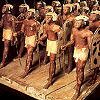
Before the New Kingdom there was no such thing as a 'standing' army in Egypt. In the event of a war the governor of each Nome was expected to raise a number of 'volunteers'. These so-called volunteers would then mass under the banner of pharaoh. This system of amassing an army was open to abuse by the wealthy of society, paying for an exemption, which in turn led to dissatisfaction and sometimes open revolt amongst the lower classes.
 |
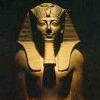 |
During the New Kingdom the army was to undergo an image change. No longer was it seen as an auxiliary role to the functioning of the state, but as an essential mechanism. A new era was ushered in, when a series of army generals exceeded the throne, starting with Tuthmosis III, who learning from experience, established a permanent professional army.
|
| ARMY MODELS |
TUTHMOSIS III |
|
|
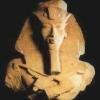
This line was briefly broken when Akhenaten assumed the throne. During his reign, military and foreign policies were ignored, resulting in a badly weakened reputation in the Levant. Egypt's reputation was to be re-established to its former exalted heights, with the next series of pharaohs and was to last for approximately 183 years.
|
 |
 |
|
|
AKHENATEN |
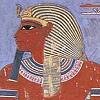
HOREMHEB |
It was Horemheb (c.1334 BC), who restored and expanded Egypt's borders, followed by Ramesses I, Seti I, Ramesses II, and finally ending with Ramesses III (c.1151 BC).
A new, superior army
 |
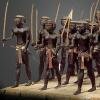 |
It was during the long military campaigns against the Hyksos that the Egyptian army learned to use the superior strategies and weapons of their enemies. The new 'model' army was based on a structured hierarchy controlled with strict discipline.
|
| WAR CHARIOT |
ARMY MODELS |
|
To encourage loyalty and bravery from his soldiers, pharaoh would award promotions, and commendations, which could take the form of gold, land or even prisoners. But the most sought after award was a promotion in social status.
In contrast to the past, the army became a privileged means of improving position and status in life. At every level of command there was a clearly defined hierarchy. However, it was possible for an educated Egyptian or simple scribe to work his way up this military hierarchy to become an officer. Opportunities were available for the upper ranks to attain nobility, which as a social class were not very knowledgeable in the art of warfare. Pharaoh insisted that his high-ranking officers were not just able leaders and strategists but also well educated. Therefore, most of the officers came from the nobility, who would occupy such ranks as archery commander, divisional commander, commander of the chariot corps or overseer of the royal stables. This last rank was the most prestigious and most highly prized.
To maintain the esteem of his officers, pharaoh would bestow generous rewards such as honorific titles, land, slaves and gold. Nothing was too good for those that contributed to Egypt's greatness. The most brilliant strategists were awarded hereditary titles associated with their rank and position. The outcome of these commendations was that a class of 'military elite' arose, who were able to command a considerable opposing force to a weak pharaoh.
Warfare at this period in time did not consist of mass ranks of disciplined armies squaring up to one another across an open plain. In fact, this only occurred once, when Ramesses II army confronted Hattusilis III army at the battle of Kadesh. After an opening skirmish, the opposing forces decided a battle would be futile and a truce was agreed with the two armies retreating. Instead, the preferred tactic was to subdue a weaker city or state one at a time resulting in a surrender of each faction until complete domination was achieved. A similar tactic was in evidence at the siege of Dapur, a heavily fortified city, standing on a hill and protected by an enormous inner and outer wall. The Egyptians exercised a war of attrition using battering rams, ladders, fire and even starvation, to overwhelm the occupants into submission.
Structure
 |
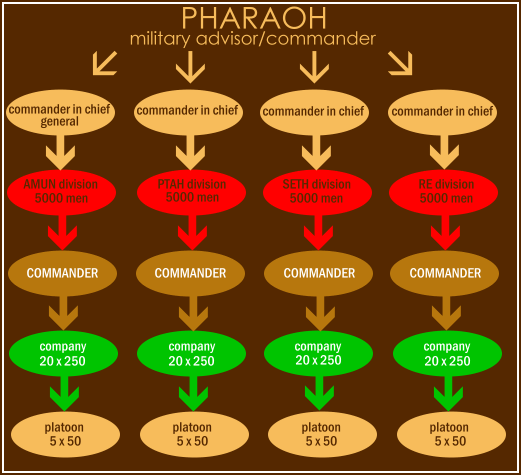
Pharaoh, as the head of the army held the title of Supreme Commander, who was assisted by his commander of the army.
The four generals were comprised from royal princes, royal favourites and high-ranking court officials, whose titles were purely consultative, and not military. While the commanders consisted of high-ranking officers, the platoon commanders were dedicated soldiers, equivalent to modern non-commissioned officers.
During the New Kingdom the army consisted of a large contingent of mercenaries, and a commander of the same ethnic origin would lead each ethnic group.
|
 |
|
BLUE WAR CROWN
|
|
Weaponry
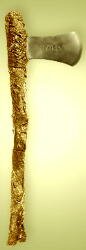
Weaponry and armour during the Old and Middle Kingdoms was basic to the extreme. The light infantry wore a belt and a G-string, whilst carrying a simple single curved bow along with primitive bronze arrow-heads. Whilst the heavy infantry were equipped with a roughly made shield constructed from wood and leather, a bronze sword, and a copper-headed spear.
 |
 |
The invasion and overthrow of Egypt by the Hyksos (c.1660-1550 BC) was due to superior military techniques and strategies. The Hyksos were already masters of mobile warfare with the advent of the horse drawn chariot, a formidable fighting machine, which the Egyptians had no answer to until they introduced their own version of the war chariot at the beginning of the 18th dynasty (c.1550-1295 BC).
It was not just the Hyksos who were more technically advanced at this time, the Syrians and Hittites had also introduced new weapons, which the Egyptians soon assimilated into its own army. These consisted of the composite bow, introduced by the Hyksos, the double-bow from the Hittites, a tasselled helmet, and short-sleeved coats of mail, consisting of a leather jacket from which metal plates were hung.
|
Ramesses II overthrew a race of people known as the Sherden, who originated from the coast of Turkey. They had a reputation of being fearsome pirates who would attack any vessels sailing too far from the Egyptian coastline.
|
These pirates were skilled mercenaries, who carried a distinctive straight sword and wore horned protective helmets. Ramesses II seconded these pirates into his army and were to play a pivotal role at the battle of Kadesh. (It is believed that it was the Sherden who came to Ramesses II aid, just as the tide of war was turning against Ramesses, preventing a humiliating Egyptian defeat.)
A new harder wearing curve bladed sword known as a Kopesh was introduced, along with stronger shields that would eventually be made from metal. However, the stronger iron weapons used by the Hittites do not seem to have been readily assimilated into Egyptian culture. The iron dagger found in Tutankhamun's tomb would appear to be for ceremonial purposes only.
|
 |
 |
The chariot
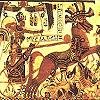
The Egyptians were not the inventors of the war chariot - this honour can be attributed to the Syrians. In fact, the first time the Egyptians saw a chariot was during the war against the Hyksos (c.1650-1550BC). The first known inscription depicting an Egyptian chariot is to be found on a scarab belonging to Thutmosis I c.1524-1518 BC pursuing a foe. The warrior pharaohs were quick to realise the military might and prowess of a mobile fighting unit and began to build up a large chariot corps of their own through trade and seizure. At Megiddo (c.1456 BC) Thutmosis III claimed to have captured 924 chariots from the defeated princes of Syria.
The Syrian chariot was a somewhat heavy and cumbersome vehicle. The Egyptians being great innovators, adapted the design to suit their own requirements:
|
They replaced the heavy cedar wood frame for one made from lighter stronger woods such as ash and birch. The heavy Syrian wheels were also improved to contain just six light spokes attached to a central hub.
The 'cockpit' was also adapted. The Egyptian version stood 75cms above the ground with a wicker platform. Unfortunately, this did not cushion the riders from jolts and vibration so later models had a tough leather platform that acted as a very basic shock absorber. The 'cockpit' was open at the back to facilitate the easy access and exit in the event of an emergency for the crew, which consisted of a driver and an archer.
The driver/charioteer had to be highly trained and have a good rapport with his horses in order to drive the unstable chariot at speed over rough terrain.
The second team member was the archer. Strapped to the side of the 'cockpit' would be two quivers of arrows and a dozen or so small pointed spears. To distinguish between corps and troops the horses were covered in bright caparisons (coats) which were embroidered with the coat of arms of the owner. A further distinction was in the use of ostrich feathered plumes, artificial flowers or streamers.
|
To become a charioteer was an honour and held in high esteem, and even received the royal seal of approval. The commander of the elite charioteers was chosen from the best and most loyal royal supporters. One of the most illustrious and prestigious titles that could be bestowed upon a soldier was that of 'Commander of his Majesty's Chariot Corps'.
Defence of the kingdom
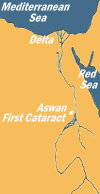
Egypt's natural borders, the Western Desert, the Sinai Desert, the Mediterranean coast and the First Cataract at Aswan have defended Egypt since the beginning of time. These were sufficient to protect the Egyptians from outside interference for centuries.
Her borders, wells and waterholes were protected by a chain of forts, each one was a day's march apart, covering an area from the Delta edge, Memphis and as far west as Umm-el-Rakham.
 |
There was a similar defensive line protecting Egypt's east border known as 'The way of the Horus', an area of 140 miles of inhospitable desert. At Sile the fort acted like a modern day custom and excises border control, requiring everybody to register by name, town of origin and intended destination before anybody was allowed entry.
A posting to one of the forts was quite lengthy and lasted for approximately 6 years. The most dreaded posting for a soldier was to the outpost fort at Umm-el-Rakham. It was some 200 miles west of Alexandria, and entailed a weeks march through hostile territory and open to attack from even more hostile nomads.
|
 |
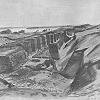 |
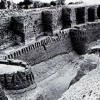
The fort was a huge sprawling structure; some 20,000 sq. meters in area and defended by mud brick walls some 5 mts thick. Access was through a solitary gate, which was guarded by pair of twin towers. The thick outer wall contained some 1,600,000 bricks so big; one man was only able to carry 2 bricks at a time.
|
The only 'perk' of such a desolate posting was that the soldiers were able to acquire foreign goods 'donated' by merchants on their way to the lucrative markets at Memphis, such as wine, olive oil even opium.
Life as a soldier
What we know of life as a soldier has come from contemporary records. We know that postings were fairly lengthy, depending on circumstances, they could be as long as 6 years and contrary to popular belief, the army was well catered for and highly regarded. This is evidenced during the Theban wars under Mentuhotep I. A mass tomb contained the bodies of sixty slain soldiers, who almost certainly died whilst campaigning in Nubia. The bodies were brought back for an Egyptian burial, so that fallen could enjoy an Afterlife, and is one of the earliest known war cemeteries.
Compare these two contrasting accounts:
| The autobiography of the noble man Ahmose, who served under three successive pharaohs: Ahmose I, Amenhotep I and Tuthmosis I, a period of 56 years, rising to the rank of officer, inscribed on his tomb walls at el-Kab: |
|
|
"I will tell you, O all ye people; I will cause you to know the honours which came to me. I was presented with gold (by the king for bravery) seven times in the presence of the whole land; male female slaves like wise. I was endowed with many fields. The fame of one valiant in his achievements shall perish in this land forever".
In his campaign against the Hyksos he boasts:
"I took captive there (Avaris) one man and three women, total four heads, and his majesty gave them to me for slaves".
For his campaigns in Nubia he was decorated twice with 'Gold of Valour'. The order of the 'Golden Fly', equivalent to the British Victoria Cross. Ahmose died an old and honoured warrior, loaded down with decorations and land.
|
|
|
An account written at a scribal school from the instructions of scribe Wenemdiamun, obviously used as a practice piece. It consists of propaganda specifically written to dissuade young men from joining the army, exaggerating the hardships of army life and has become known as the Papyrus Anastasaia.
|
|
|
"Come let me tell you the woes of the soldier ... He is called up to go to Syria. He is not permitted to rest. There are no clothes and no sandals. The weapons of war assembled at fort Sile. He has to march uphill, through the mountains. He drinks water every third day, and then it is tainted and smells of salt. His body is racked with sickness. The enemy comes and surrounds him with weapons and life ebbs away from him…When the army is victorious the captives are handed over to pharaoh and must be escorted to Egypt. The foreign women faint on the march; the soldier is forced to support her. While he is supporting the woman he drops his pack and it is stolen. His own wife and children are back at home in the village; he dies and does not reach it. If he survives he is worn out through marching …"
|
Return to the main article page >>
|
|
|


